When to Stay Home – Obey the Triangle!

I have finally learned this lesson, in late 2013, many many years after I learned to drive in New England ice and snow: When the forecast includes the word “Winter Storm Warning” or “Winter Weather Advisory,” the decision is STAY HOME.

This is the symbol.  OBEY THE LITTLE ORANGE TRIANGLE!

Active Advisory!

It’s so easy for me to think that I can get where I want to go before everyone else or that the roads won’t be as bad as “they” say or that the forecast is just “off” by some amount of time.  These are all terrible assumptions.  But the worst assumption of all is that the thing I just must attend, the important event and reason to get from Point A to Point B at this specific time, during this winter weather, is important enough to take the chance.

It isn’t.  It’s all miss-able.  Really.

This year, I found myself in a scary white-knuckle drive home from a mid-day company holiday party, with many of other foolish people slipping and sliding, some of them right off the road.   Finally, I learned my lesson: the orange triangle means stay home.

There is a cost to being this conservative, of course.  It means that there will also be really fun events that I’ll miss, due to the little orange triangle’s warning, and then find out that the roads were fine after all.  That happened to me within mere days of learning this lesson.  But that’s the deal – you can’t have it both ways.

It’s snowing and icy out there now.  There is a little orange triangle on my screen.  And I’m staying home.

Poached

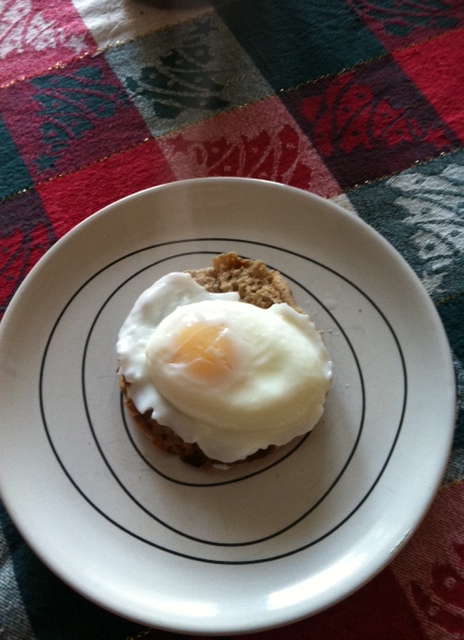
Today I learned how to poach an egg.

Our family has a collection of gadgets to “sort of poach” eggs.  My mom has a pan with a metal insert.  Sally has a microwave gadget. Kat has a cup you float in boiling water.  Steve and I have a blue screw-top egg that goes in the microwave.  A conversation with Sally inspired me to learn to actually poach an egg, the old-fashioned way.

It turns out that it is incredibly easy, following my 1970’s Betty Crocker Cookbook instructions: Boil then simmer one to two inches of water in a pan.  Crack an egg into a bowl or saucer and slip it into the simmering water.  If you have multiple eggs, give them room so that they are not touching.  Optionally, spoon some hot water over the top.  When it’s cooked enough, use a slotted spoon to lift the egg out of the water.

My First Poached Egg

Another day, I will learn to take really good food pictures: to set them up attractively, consider the background, add garnishes, all of it.  (I know a great teacher!)  But if there is one thing I’ve learned from my time posting lessons and the recent many months not posting lessons, it’s to not let the perfect drive out the good.  If I want to continue with sharing what I’ve learned, and I really do, then I have to be OK with imperfect and done.

So stay tuned!


Get the Facts, Jack!

9:15 AM  I am so happy that I made it to yoga class.  I love my yoga studio.  Wow, there are only three other women here.  Well, it is a Thursday.  They all look kind of buff.  Oh well, if I’ve learned anything from a two decades of yoga, it should be to do my own thing and not compare myself to others.

9:20 AM Start with some downward facing dogs.  That’s cool.  And a bunch of planks.  Wait, you want me to do “reps” here?  I don’t know if I’ve ever even heard the word “rep” at yoga before.  I like this teacher, her instructions are clear, but why isn’t she doing this along with us?

9:25 AM I take that back.  This teacher is way too focused on “core” routines.  When I leave, I’m checking the schedule.  I know there is variation in different teachers’ ideas of “Hatha Yoga” but this feels more like a Core class!  OK now I get why she’s not doing this with us, she’s seven months pregnant!  But from now on I’m making sure someone else is teaching Hatha before I show up.

9:30 AM More “reps”??????  Are you kidding me.  This whole thing could be a core class.  This is so hard!!!

9:35 AM Wait…

9:40 AM OMG Is this a Core class?   Isn’t the schedule 9:15 every day Hatha Yoga?  I know it is on Friday and Saturday and Sunday.   It must be a different class on Thursdays!

9:45 AM Well Jane, enjoy your Core class!  It’s hard, but it’s good!  It’s just not Yoga

9:50 AM If I live through this, I am going to write a post for JanesLessonsLearned and say that today I learned to CHECK THE SCHEDULE!!!


For the Hardest Times of All: Comfort In / the Ring Theory of Kvetchinng

Just as Someone I Love was asking how to help her friend in a horrible medical situation, this pops up somewhere on my screen, from the LA Times, on the Ring Theory of Kvetching.

They say it better than I can, so I’m posting it all right here:

How not to say the wrong thing

It works in all kinds of crises – medical, legal, even existential. It’s the ‘Ring Theory’ of kvetching. The first rule is comfort in, dump out.

The rules of kvetching

(Illustration by Wes Bausmith / Los Angeles Times)

Susan Silk and Barry Goldman

April 7, 2013


When Susan had breast cancer, we heard a lot of lame remarks, but our favorite came from one of Susan’s colleagues. She wanted, she needed, to visit Susan after the surgery, but Susan didn’t feel like having visitors, and she said so. Her colleague’s response? “This isn’t just about you.”

“It’s not?” Susan wondered. “My breast cancer is not about me? It’s about you?”

The same theme came up again when our friend Katie had a brain aneurysm. She was in intensive care for a long time and finally got out and into a step-down unit. She was no longer covered with tubes and lines and monitors, but she was still in rough shape. A friend came and saw her and then stepped into the hall with Katie’s husband, Pat. “I wasn’t prepared for this,” she told him. “I don’t know if I can handle it.”

This woman loves Katie, and she said what she did because the sight of Katie in this condition moved her so deeply. But it was the wrong thing to say. And it was wrong in the same way Susan’s colleague’s remark was wrong.

Susan has since developed a simple technique to help people avoid this mistake. It works for all kinds of crises: medical, legal, financial, romantic, even existential. She calls it the Ring Theory.

Draw a circle. This is the center ring. In it, put the name of the person at the center of the current trauma. For Katie’s aneurysm, that’s Katie. Now draw a larger circle around the first one. In that ring put the name of the person next closest to the trauma. In the case of Katie’s aneurysm, that was Katie’s husband, Pat. Repeat the process as many times as you need to. In each larger ring put the next closest people. Parents and children before more distant relatives. Intimate friends in smaller rings, less intimate friends in larger ones. When you are done you have a Kvetching Order. One of Susan’s patients found it useful to tape it to her refrigerator.

Here are the rules. The person in the center ring can say anything she wants to anyone, anywhere. She can kvetch and complain and whine and moan and curse the heavens and say, “Life is unfair” and “Why me?” That’s the one payoff for being in the center ring.

Everyone else can say those things too, but only to people in larger rings.

When you are talking to a person in a ring smaller than yours, someone closer to the center of the crisis, the goal is to help. Listening is often more helpful than talking. But if you’re going to open your mouth, ask yourself if what you are about to say is likely to provide comfort and support. If it isn’t, don’t say it. Don’t, for example, give advice. People who are suffering from trauma don’t need advice. They need comfort and support. So say, “I’m sorry” or “This must really be hard for you” or “Can I bring you a pot roast?” Don’t say, “You should hear what happened to me” or “Here’s what I would do if I were you.” And don’t say, “This is really bringing me down.”

If you want to scream or cry or complain, if you want to tell someone how shocked you are or how icky you feel, or whine about how it reminds you of all the terrible things that have happened to you lately, that’s fine. It’s a perfectly normal response. Just do it to someone in a bigger ring.

Comfort IN, dump OUT.

There was nothing wrong with Katie’s friend saying she was not prepared for how horrible Katie looked, or even that she didn’t think she could handle it. The mistake was that she said those things to Pat. She dumped IN.

Complaining to someone in a smaller ring than yours doesn’t do either of you any good. On the other hand, being supportive to her principal caregiver may be the best thing you can do for the patient.

Most of us know this. Almost nobody would complain to the patient about how rotten she looks. Almost no one would say that looking at her makes them think of the fragility of life and their own closeness to death. In other words, we know enough not to dump into the center ring. Ring Theory merely expands that intuition and makes it more concrete: Don’t just avoid dumping into the center ring, avoid dumping into any ring smaller than your own.

Remember, you can say whatever you want if you just wait until you’re talking to someone in a larger ring than yours.

And don’t worry. You’ll get your turn in the center ring. You can count on that.

Susan Silk is a clinical psychologist. Barry Goldman is an arbitrator and mediator and the author of “The Science of Settlement: Ideas for Negotiators.”


The Importance of Staying Down to Earth

Today’s Lesson Learned comes to you from my first art show, which was all fun and games until the wind whipped up, slammed down my carefully placed display of paintings and upended the 10×10 “pop-up” tent and sent it flying.  It was sad, it was scary, and it was unnecessary, because the word of the day is ballast. 

Here is the before picture, which features my booth designer, Jill, on the 86th and final placement of the featured items:

Uncommon Art BoothIt was awesome while it lasted.

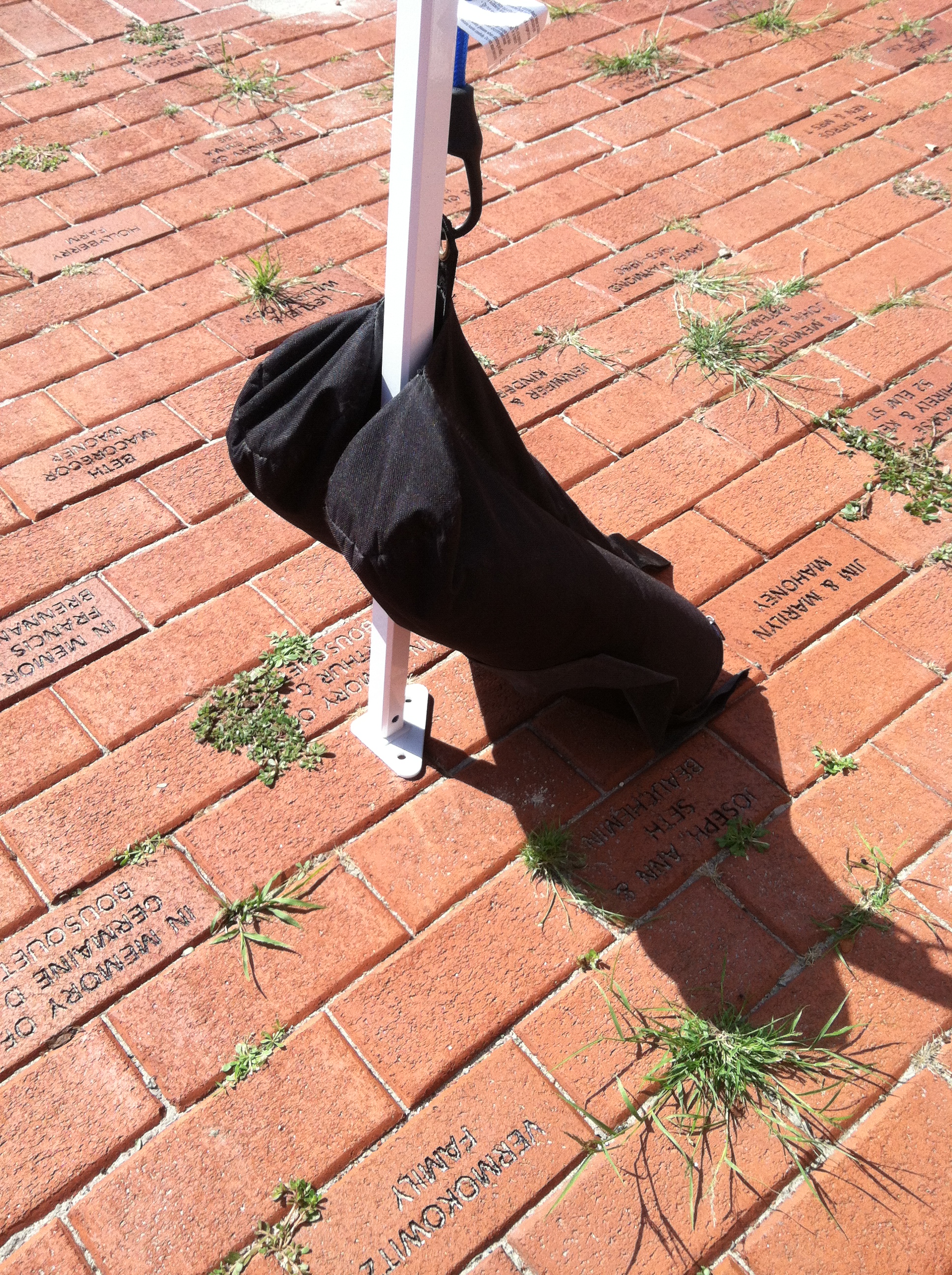
The other artists, the seasoned/smart ones, had some kind of weight to keep the booth in place.  Some had jugs of sand, some had cement blocks, some had bags of sand like this:

ballast, it works
ballast, it works

I learned many things on the way to this show, including how to frame a canvas board, how to make professional-quality art prints, and how to use Photoshop to make industry-standards greeting card layouts from my paintings.  I learned (again) that I love the creative process around creating and marketing a product.

You can see the art up close here: http://www.JaneBrzArt.com, and you can also find out if I will be doing this again (once I find out.)  If it’s outdoors, you can be sure that I’ll be anchored away!


How to Save a Life

Right this very minute, my cousin Zach is donating bone marrow in an effort to save the life of  a man with lymphoma, someone she doesn’t know.

In the old days, you had to go to a “bone marrow drive” and undergo a blood test for a future match.  Now it couldn’t be easier to find out if someone needs you in order to live: You click the link below, they send you a kit, you swab your cheek and you send it back!

Click here to learn more and/or to sign up! 

I’ve been on the register for years, but never called.  If I’m not a match yet, maybe you are! 

I’ll let you know what I learn from Zach!  

Tag It then Wear It or Toss It

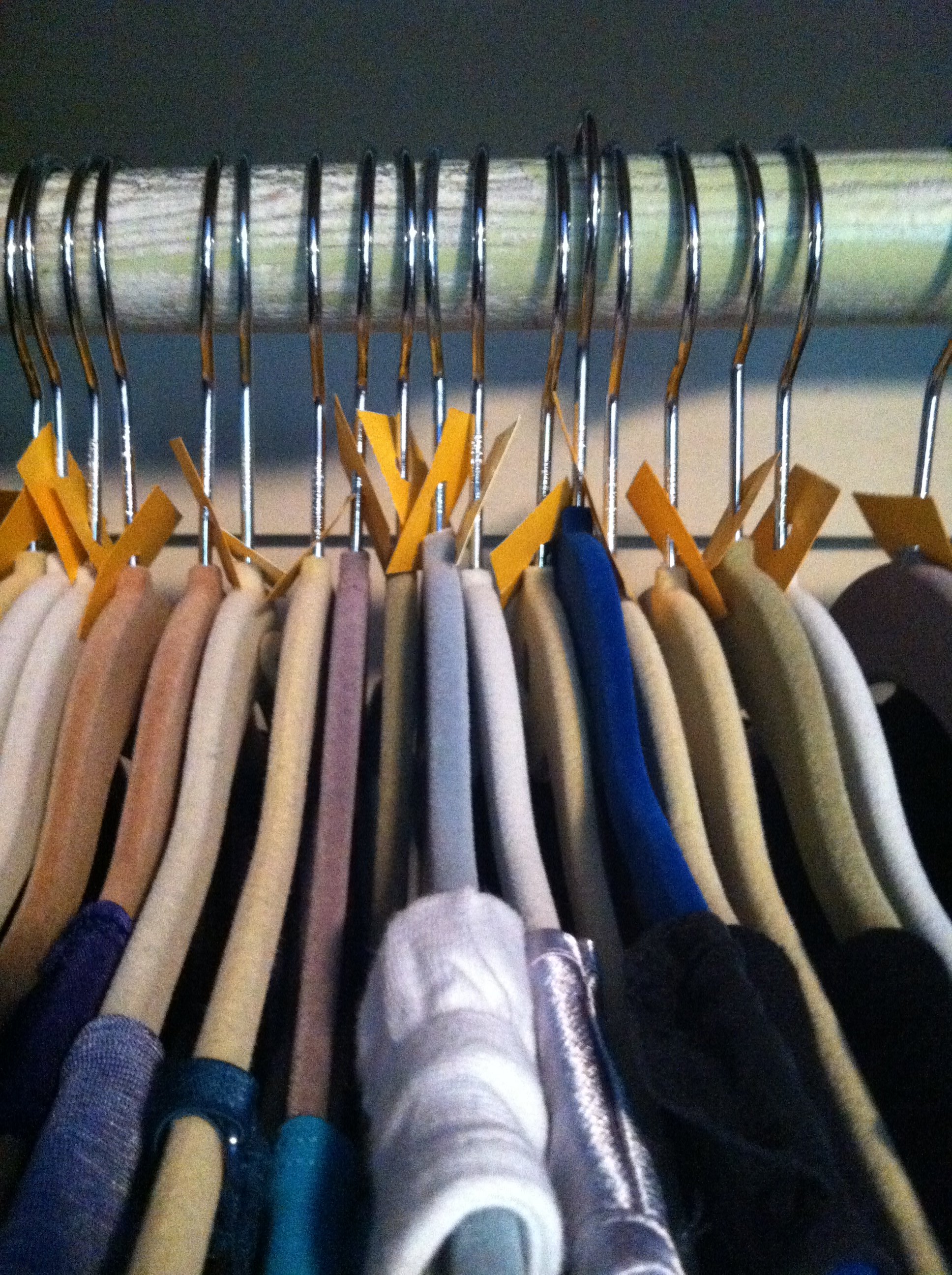
I learned this one from the fabulous resource, Jill’s Closet!  I went through every single (hanging ) item of clothing I own, and pulled out anything I don’t wear, for donation or other destinations.  For the rest, ones I think I wear, I put a tag on every hanger:

Tag it!
Tag it!

I cut small squares of card stock (I love my paper cutter!) and punched a hole in the middle of each one, then slid them over the hangers of the keepers-for-now.

The idea is this: Every time I wear an item from now on, I will remove the tag.  A year from now, anything that still has its tag is going to have to make a darn good case for me to keep it.

Let’s see what I learn from this!